
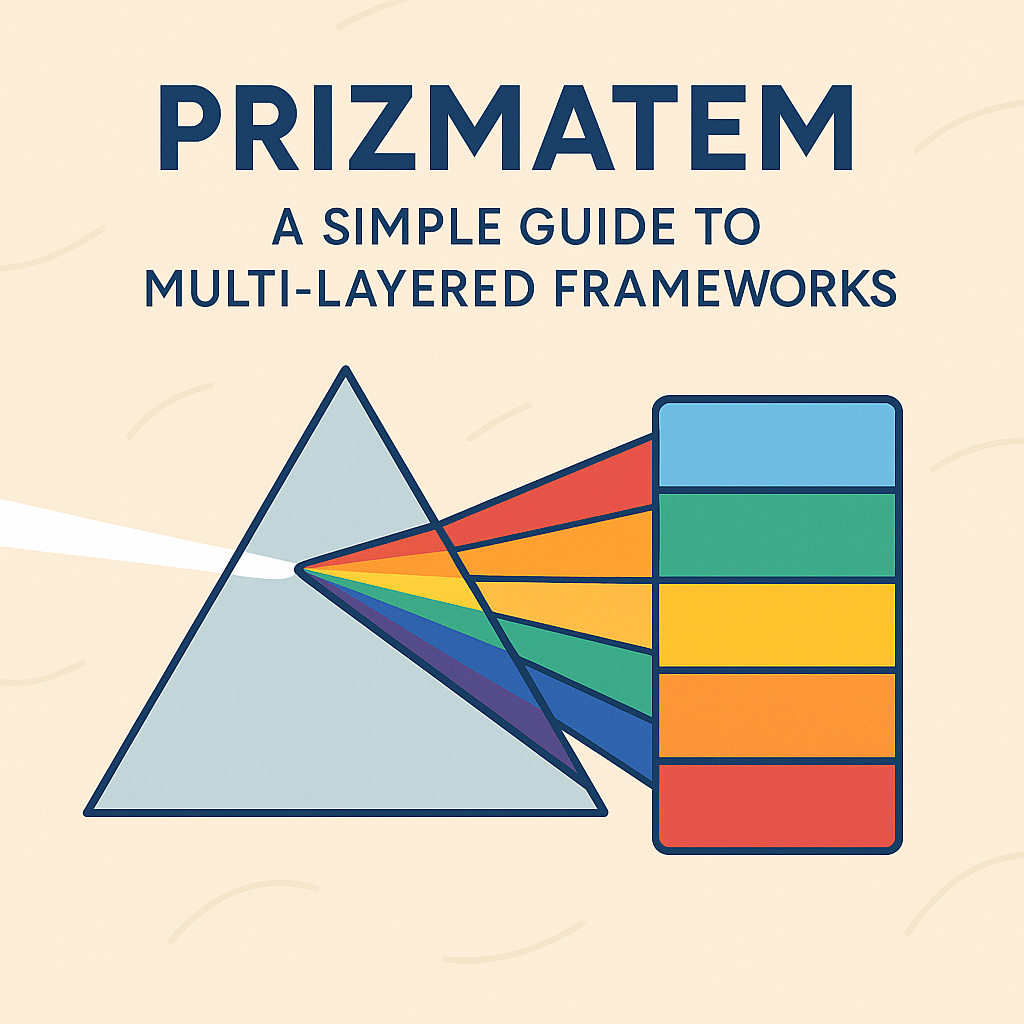
Today, we live in a world full of complex problems. Technology, design, and education are moving fast. To keep up, we need tools that make things simple and clear. One such tool is Prizmatem.
The idea of Prizmatem comes from a prism. A prism takes white light and splits it into many colors. In the same way, Prizmatem takes a single problem and breaks it into smaller, easy to understand parts. This helps people and teams find better answers and build smarter systems Non Polar Dielectric.
What Does Prizmatem Mean?
-
Prism = light, clarity, many views.
-
System/Element = structure, rules, or parts.
-
Together = a framework that splits one idea into many angles, and then joins them back to make a full solution.
Main Principles of Prizmatem
Prizmatem works on a few simple rules:
-
Many views – Break one big problem into smaller parts.
-
Modules – Build in layers so each part can stand alone.
-
Transparency – Keep things clear and easy to explain.
-
Adaptability – Be ready to change when the input changes.
-
Scalability – Start small but grow bigger when needed.
How Prizmatem Is Built
| Part | Role | Example |
|---|---|---|
| Input Layer | Collects the raw problem or data | A design brief, numbers, or a signal |
| Facet Layer | Splits it into smaller pieces | Colors, financial reports, customer data |
| Processing Layer | Works on each piece | AI, visualization, or light refraction |
| Synthesis Layer | Joins the pieces back | A final design, a report, or an AR scene |
| Feedback | Learns from results | User testing, machine learning updates |
Simple Workflow
Prizmatem follows a clear path:
-
Step 1: Input – Take in the data or idea.
-
Step 2: Split – Break it into layers or perspectives.
-
Step 3: Process – Improve or refine each layer.
-
Step 4: Join – Bring the layers back into one solution.
-
Step 5: Feedback – Adjust and improve based on results.
Where Can We Use Prizmatem?
-
Design and Visuals
-
Use layers for color, form, and accessibility.
-
Create designs that are both creative and user friendly.
-
-
Education
-
Break lessons into text, visuals, and practice.
-
Support different learning styles in classrooms.
-
-
Business and Data
-
Split big data into clear views like customer, finance, and operations.
-
Help leaders make faster and better decisions.
-
-
Augmented and Virtual Reality
-
Layer digital objects on the real world.
-
Improve realism in games, training, or design apps.
-
-
Communication and Networks
-
Use light signals (visible or infrared) instead of radio waves.
-
Build fast and secure data systems.
-
-
Work and Productivity
-
Break projects into simple tasks.
-
Improve teamwork and efficiency.
-
Benefits of Prizmatem
-
Gives clarity – makes hard problems simple.
-
Improves flexibility – works in many fields.
-
Boosts efficiency – reduces wasted effort.
-
Increases engagement – makes outputs easier to use.
-
Supports growth – works for small or big systems.
Challenges to Keep in Mind
-
Hard to connect with old systems.
-
Extra layers can slow down performance.
-
Needs modern hardware in AR or optics use.
-
Users may face a learning curve.
-
More layers can mean more security risks.
Future of Prizmatem
-
Smarter modules – self learning layers that adapt on their own.
-
Prediction – systems that guess needs before users ask.
-
New materials – better prisms and sensors for real world uses.
-
Open standards – shared rules so many companies can use it.
-
Research – new studies in AI, education, and optics.
How to Start With Prizmatem
-
Begin with one small project.
-
Make sure each layer has a clear role.
-
Use known design patterns for safety.
-
Add tools like AI libraries or visualization apps.
-
Always include feedback loops for improvement.
Real Life Style Examples
-
UI/UX Design: A team builds an app with separate layers for looks, function, and accessibility.
-
Education: A math course has lessons, animations, and quizzes built as layers.
-
Architecture: A building uses prisms in the façade to guide sunlight and save energy.
-
Business: A company splits reports into customer, cost, and growth views for strategy planning.
Key Takeaways
-
Prizmatem is about splitting and joining ideas like a prism does with light.
-
It helps in design, education, business, AR/VR, and networks.
-
The framework gives clarity, flexibility, and efficiency.
-
It faces challenges like complex setup and security risks.
-
Its future is bright, with potential in AI, optics, and productivity.
Frequently Asked Questions
1. What is Prizmatem?
Prizmatem is a framework that breaks down complex problems into smaller layers, like a prism splitting light into colors. It helps in design, business, education, and technology.
2. How does Prizmatem work?
Prizmatem works in five steps: input, split, process, join, and feedback. It collects data, divides it into layers, processes each part, combines them, and then improves based on feedback.
3. Where can Prizmatem be used?
Prizmatem can be used in many fields:
-
Design and visuals
-
Education and learning
-
Data analysis and business intelligence
-
Augmented and virtual reality
-
Communication systems
-
Productivity and workflow
4. What are the benefits of Prizmatem?
The key benefits of Prizmatem are:
-
Clear understanding of complex issues
-
Flexible use across industries
-
Higher efficiency and speed
-
Better user engagement
-
Easy growth from small to large projects
5. What challenges come with Prizmatem?
Challenges include:
-
Difficult integration with old systems
-
Possible performance slowdowns
-
Need for advanced devices in AR or optics
-
A learning curve for new users
-
Security risks from multiple layers
6. Is Prizmatem only for technology?
No. While Prizmatem is popular in tech fields like AI, AR, and communication, it is also useful in design, education, business planning, and creative industries.
7. What is the future of Prizmatem?
The future of Prizmatem may include smarter self learning modules, predictive systems, new prism based hardware, open standards for sharing, and research in AI and optics.
Conclusion
Prizmatem is more than just a tool. It is a way of thinking. It shows us that every problem has many sides, and by looking at each side, we can build stronger, smarter solutions.
Just as a prism turns one beam into a rainbow, Prizmatem turns one idea into many clear views. And by bringing them back together, it creates results that are richer, sharper, and more useful.